
Calculating Yield and ROI from Your Hydroponic System
You can calculate yield and ROI for a home hydroponic system by tracking how many pounds of produce you harvest per square foot per year, the price you would otherwise pay for that produce, and the real costs of your system (setup plus electricity, nutrients, water, and supplies). For most small indoor gardens, leafy greens and herbs give the fastest payback, while fruiting crops like tomatoes and peppers take longer but can still be profitable with good lighting and system design. Once you know your annual harvest value and annual costs, you can estimate ROI with a simple formula and decide whether your system is saving or making you money.
TL;DR: Track your harvest weight and store prices, subtract your yearly operating costs, and divide by your setup cost to estimate ROI. Leafy greens and basil in compact NFT, DWC, or tower systems usually deliver the best yield per square foot and the quickest payback for home and apartment growers.
What does “yield” mean in a home hydroponic system?
In a home or apartment hydroponic setup, yield usually means how many pounds of edible produce you harvest per square foot of growing area per year. Commercial operations often report yields per tower, channel, or square meter, but the same idea applies on a small scale in your living room or balcony.
For practical home use, you can track yield in three ways: per plant (useful for tomatoes or peppers), per square foot (great for lettuce and basil), or per system (for a full tower or tent). Choose one main method and be consistent so you can compare results over time.
How much yield can you expect from common hydroponic crops?
Commercial data shows that hydroponic lettuce, basil, and other leafy greens can produce significantly more per square foot than traditional soil beds when light and nutrients are optimized. For basil, research has found that increasing planting density and light levels can boost yield per square foot without hurting individual plant size, which is encouraging for small indoor systems.
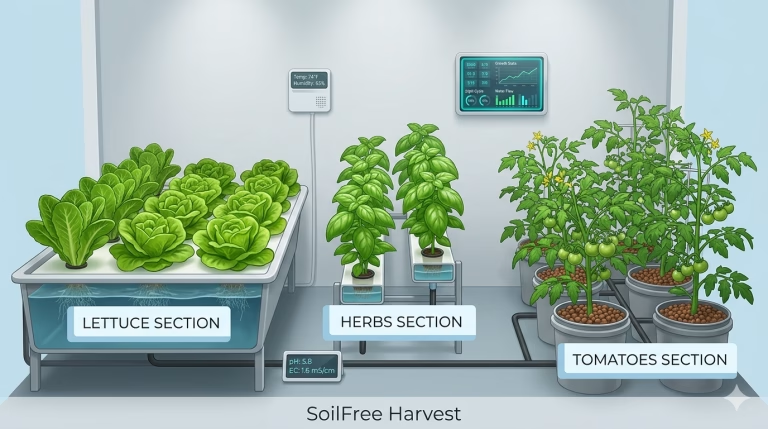
Here are realistic ballpark ranges for home growers using good LED lighting and stable pH/EC, assuming 8–12 square feet of active growing area:
| Crop type | Typical system types | Approx yield per ft² per harvest | Harvests per year | Annual yield per ft² (rough range) |
|---|---|---|---|---|
| Lettuce & leafy greens | DWC, NFT, towers, raft | 0.3–0.5 lb | 10–12 | 3–6 lb |
| Basil & soft herbs | DWC, NFT, towers, kratky | 0.3–0.6 lb | 10–14 | 4–8 lb |
| Tomatoes (indeterminate) | Dutch buckets, larger DWC, media beds | 8–20 lb per plant per year (home scale) based on commercial ranges | 1 season | 8–20 lb per plant |
| Strawberries | NFT, towers | 0.5–1.5 lb per plant per year | 1–2 seasons | 0.5–1.5 lb per plant |

These are guideline ranges, not guarantees. Your actual yield depends on light intensity and hours, temperature, cultivar, pruning, and how dialed in your pH and EC are.
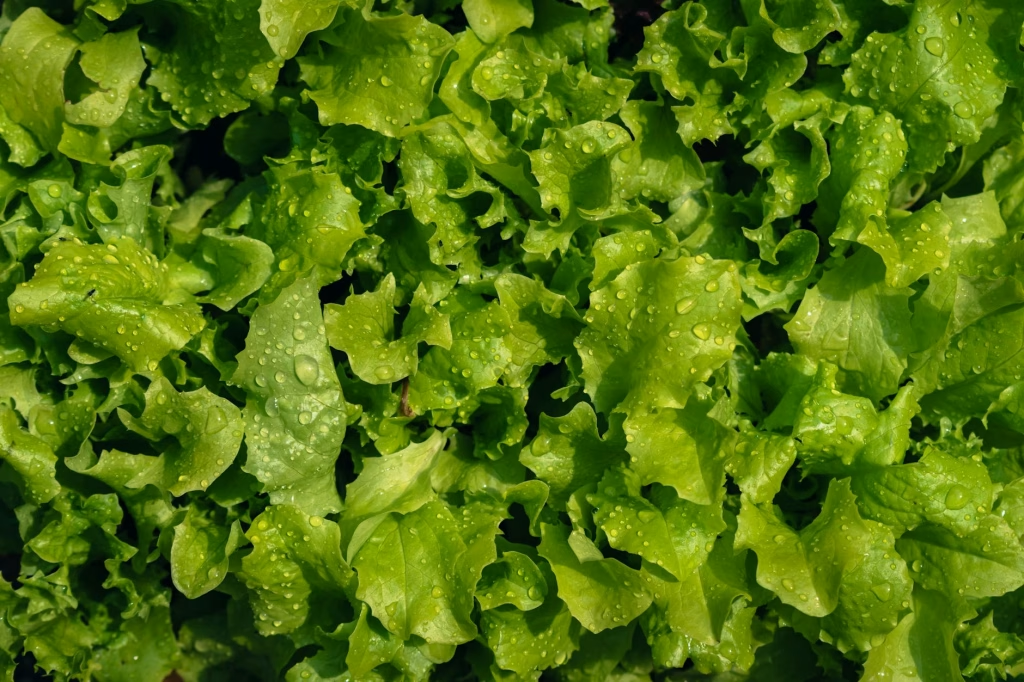
Depending on your demographics – heirloom lettuce and unique varieties can attract more buyers. One of my favorites is the Lolla Rosa (affiliate link) lettuce with it’s unique pink edges. We grow it for our home salads as a cut-and-come again lettuce.
Best hydroponic plants → Best crops for indoor hydroponic systems
What costs matter when you calculate hydroponic ROI at home?
To understand ROI, you need to separate one-time setup costs from ongoing operating costs. Setup costs include the system itself (tote, buckets, channels, tower, fittings), LED grow lights, basic tools, and meters for pH and EC, which for home systems usually run from about 50 dollars to several hundred dollars depending on size and quality.
Operating costs are recurring: electricity for lights and pumps, nutrients, water, replacement media, and occasional repairs. Nutrient solutions often cost around 20 to 50 dollars per month for hobby setups, while electricity for a medium indoor garden can be in the range of 30 to 40 dollars per month depending on wattage, hours of use, and local rates.
Hydroponic nutrients guide → choosing hydroponic nutrients
How do you calculate electricity costs for a hydroponic system?
Electricity is usually the largest ongoing cost for indoor growers. Guides that model typical home systems estimate that a medium setup with a 300 watt LED plus pumps and a heater can use about 7.5 kWh per day, translating to about 225 kWh per month, which at 0.15 dollars per kWh is roughly 34 dollars per month.
You can calculate your own electricity use with a simple formula:
- Multiply each device’s wattage by hours used per day, then divide by 1000 to get kWh.
- Add all kWh values for your lights, pumps, and fans to get total daily kWh, then multiply by 30 and by your local kWh price.
For example, a 200 watt LED on 16 hours per day uses about 3.2 kWh daily, so at 0.15 dollars per kWh that light alone costs about 14 dollars per month.
Hydroponic grow lights → LED lighting for indoor hydroponics
How do you calculate ROI for a home hydroponic system?
Return on investment compares how much money your system saves or earns to what it cost to set up. Business and farming guides typically calculate ROI as net profit divided by initial investment, multiplied by 100 to express it as a percentage.
For a home system, treat “revenue” as the value of food you no longer buy at the store. Use this formula:
- Annual harvest value = total pounds harvested × price per pound you would normally pay.
- Annual operating cost = electricity + nutrients + water + media + small supplies.
- Net benefit per year = harvest value − operating cost.
- ROI (%) = (Net benefit per year ÷ initial setup cost) × 100.
If the net benefit equals your initial cost, your ROI is 100 percent and you have reached payback.
Example: What is the ROI of a small lettuce and basil system?
Consider an 8 ft² indoor NFT or DWC setup growing lettuce and basil for one household. Commercial tower and channel operations report about 5–7 lb of lettuce or basil per tower or set of channels every 3–4 weeks, which translates down to roughly 0.3–0.5 lb per ft² per harvest in dense systems.
Assume you harvest an average of 4 lb of greens per month at a local price of 4 dollars per pound (organic or premium grocery pricing). Your annual harvest value would be 192 dollars. If your lights and pumps cost 20 dollars per month in electricity and nutrients plus media cost another 15 dollars per month, your annual operating cost would be 420 dollars. That would be a negative net benefit in pure dollars, but many home growers reduce costs with efficient LEDs, cheaper nutrients, and free or filtered tap water so the balance shifts over time.
If upfront hardware cost 250 dollars and you optimize operating costs down to 15 dollars per month with good LEDs and bulk nutrients, you might get:
- Annual harvest value: 192 dollars
- Annual operating cost: 180 dollars
- Net benefit per year: 12 dollars
- ROI: (12 ÷ 250) × 100 = 4.8 percent
That seems small, but if you scale to 16–24 ft², use cheaper electricity off-peak, or grow higher value herbs like basil that can command 16 dollars per pound in some markets, the numbers can improve quickly.
Basil in hydroponics → Indoor Hydroponic Herbs
Which crops deliver the best ROI in home hydroponics?
Profitability analyses and crop lists for hydroponic farms consistently show that herbs and leafy greens are the most efficient crops in terms of yield, turnover speed, and price per pound. Lettuce, spinach, and salad mixes offer fast 3–5 week cycles, while basil and specialty herbs like mint or cilantro can command premium prices in stores and restaurants.
For home growers interested in ROI, focus on:
- Leafy greens: romaine, butterhead, leaf lettuce, spinach, kale.
- Herbs: basil, mint, cilantro, parsley, dill, chives.
- Compact fruiting crops: cherry tomatoes, peppers, strawberries, especially if you value flavor and are replacing expensive supermarket clamshells.
How do different hydroponic systems affect yield and ROI?
Different system types offer different tradeoffs between cost, complexity, and yield per square foot. High density vertical systems and NFT channels maximize plant count in small spaces, while bucket and media systems suit larger plants but with fewer units per square foot.
Here is a practical comparison for home and apartment growers:
| System type | Typical crops | Setup cost (small home scale) | Yield & ROI notes |
|---|---|---|---|
| DWC (buckets/totes) | Lettuce, herbs, small tomatoes | Low to moderate | Simple and forgiving, good yield per plant but less dense than NFT or towers. |
| NFT channels | Lettuce, basil, strawberries | Moderate | High plant density and quick cycles, strong yield per ft² but needs careful setup. |
| Vertical towers | Greens, herbs, strawberries | Moderate to higher | Excellent space efficiency and yield per ft²; good option when floor space is limited. |
| Dutch buckets | Tomatoes, peppers, cucumbers | Moderate | High yield per plant and good flavor, but slower cycles and lower plant density. |
| Media beds | Mixed crops, including roots | Moderate | Versatile but heavier and less space efficient for pure ROI. |
NFT, vertical towers, and compact DWC systems usually provide the best ratio of food per dollar of hardware and electricity for small spaces. Dutch buckets and media beds shine when you value large fruiting crops and variety more than raw efficiency.
How do you value your harvest for ROI calculations?
To calculate harvest value, use the price you would realistically pay in your local store. Many hydroponic economic guides use wholesale numbers, but home growers buy at retail prices, which are often higher.
A simple approach is to track each harvest in a notebook or spreadsheet with date, crop, weight, and store price per pound or per package. For mixed harvests like herbs you can convert grocery clamshell pricing to a per pound value by checking package weights and shelf prices.
How long does it take for a home hydroponic system to pay for itself?
Commercial guides often show ROI timelines of 1 to 3 years for well run hydroponic farms, compared with 3 to 5 years for traditional soil farming. For home systems, payback time depends almost entirely on your system size, crop choice, and electricity rate.
If your system costs 300 dollars to build and generates a net benefit of 75 dollars per year (harvest value minus operating costs), you would reach payback in 4 years. If you double your productive area or focus on higher value herbs so your net benefit rises to 150 dollars per year, payback shortens to about 2 years. The more you use your system and the more consistently it produces, the faster your ROI improves.
How-to: calculate yield and ROI for your hydroponic system
Title: How to Calculate Yield and ROI for a Home Hydroponic System
Description: A practical process to measure how much food your system produces, what it would cost in stores, and whether your setup is paying for itself.
Materials / Tools:
- Kitchen scale (grams or ounces)
- Notebook or spreadsheet
- Recent grocery receipts or local price lookup
- Basic system info: setup cost, monthly electricity estimate, nutrient cost, and water cost
1. Define your measurement period
Choose a 3 month, 6 month, or 12 month window so you can capture multiple harvest cycles, especially for lettuce, herbs, and fast greens. A full year is best for fruiting crops like tomatoes and strawberries so seasonal light changes are averaged out.
2. Track every harvest by weight
Each time you harvest, weigh your produce before eating or preserving it. Write down the date, crop type, and weight, keeping separate totals for lettuce, herbs, fruiting crops, and microgreens if you grow them. Over time, this gives you a clear picture of yield per crop and per month.
3. Record local prices for the same produce
Use grocery receipts or a quick price check to find what you would pay locally for each crop type per pound or per package. Note whether you usually buy organic or conventional, and keep prices updated a few times per year since markets change.
4. Calculate harvest value
For each crop, multiply the total harvested weight by the local price per pound. Sum across all crops to get your total “harvest value” for the measurement period, which represents money you did not spend at the store.
5. Calculate operating costs
Add up your monthly expenses for electricity, nutrients, media, filters, and water (even if water is cheap, include a small estimate for completeness). If you are in a hot climate like Phoenix and must run extra fans or AC for your grow tent, add a reasonable share of those costs. Multiply the monthly total by the number of months in the measurement period.
6. Include setup costs
List your one time setup expenses: system hardware, LEDs, timers, meters, basic plumbing, and any control electronics. For ROI, use the original total cost, but for year over year comparisons you can amortize this number over several years if you want a more conservative view.
7. Compute net benefit
Subtract your operating cost for the period from your harvest value. If the result is positive, your system is saving you money on groceries. If it is negative, you are paying a premium for fresh, controlled produce, which may still be worth it for quality and resilience.
8. Calculate ROI and payback time
Use the net benefit from a full year and divide by your setup cost, then multiply by 100 to get your percentage ROI. To find payback time, divide the setup cost by the annual net benefit to estimate how many years it will take for the system to pay for itself.
9. Improve ROI with targeted tweaks
Once you know your numbers, adjust your system for better performance. Increasing planting density for basil, extending light hours in winter, or switching to more efficient LEDs can all boost yield per square foot and reduce operating costs, improving your ROI over time.
What practical tips improve hydroponic ROI in hot, dry climates?
Research on hydroponic ROI highlights that water efficient recirculating systems can boost yields while cutting both water and fertilizer waste, which is especially valuable in water scarce regions. In hot, dry climates like Phoenix, managing water temperature, evaporative losses, and LED efficiency is critical because cooling loads and reservoir heat can erode your profit margin.
Useful tips include:
- Insulate reservoirs and keep nutrient solution temperatures in the mid 60s to low 70s Fahrenheit to protect roots and reduce chiller or AC use.
- Run lights during off peak power hours if possible and use high efficacy LEDs to get more light per watt.
- Favor fast cycling crops that do not require long, high light seasons, such as lettuce and basil, instead of energy hungry long vine tomatoes.
Water efficient hydroponics → hydroponics for drought and water shortages
FAQ: Yield and ROI in home hydroponics
How much does a small home hydroponic system really cost to run?
Most guides suggest that nutrients for a modest home system cost about 20 to 50 dollars per month, while electricity for lights and pumps can add 10 to 40 dollars depending on system size and local rates. Water costs are usually minimal compared with these two, especially in recirculating systems that reuse solution.
Is hydroponics cheaper than buying vegetables at the store?
For leafy greens and herbs, hydroponics can be cost competitive or cheaper than store bought produce if you keep electricity costs under control and run your system year round. For fruiting crops, the pure dollar ROI is often lower, but quality, flavor, and reliability can make the tradeoff worthwhile.
How long until my hydroponic system pays for itself?
Commercial case studies show ROI timelines of 1 to 3 years for efficient hydroponic operations, and home systems often fall in that range if you grow high value crops regularly. If you only run the system seasonally or focus on low value crops, payback can take longer or may never fully materialize in strict financial terms.
Which hydroponic crops give the fastest payback?
Lettuce, salad mixes, spinach, and herbs like basil and mint give the fastest payback because they grow quickly, pack tightly, and command good prices in stores. They also use less light and nutrient strength than heavy fruiting crops, keeping operating costs modest.
Are hydroponic systems worth it if my ROI is low?
Even if your strict dollar ROI is low or negative, hydroponics can still be valuable for food security, freshness, and control over pesticides and contaminants. Many home growers view the system as a combined grocery, hobby, and resilience investment rather than a pure financial vehicle.
How can I improve my hydroponic ROI without rebuilding everything?
Common strategies include increasing planting density for herbs and greens, upgrading to more efficient LEDs, and tightening your nutrient regimen to avoid waste. Switching part of your grow space from low value crops to higher value herbs or specialty greens can also boost the value of each harvest.
What is a realistic yield goal for a small apartment system?
For a compact 8 to 12 ft² system, aiming for 3 to 6 lb of leafy greens per square foot per year is a reasonable goal with good lighting and management. That translates to a steady supply of salads and herbs for one or two adults, reducing weekly trips to the produce aisle.
Do vertical towers really improve ROI in small spaces?
Vertical tower case studies show very high plant counts and strong yields per square meter, especially for lettuce and basil, which can lead to impressive monthly outputs in limited footprints. For apartment growers, towers often offer better ROI per square foot of floor space, though the initial hardware investment is usually higher than a simple DWC tub.g
I am a cybersecurity engineer and hydroponics enthusiast based in the Phoenix area, growing indoors to beat intense desert heat and ultra low humidity. From multiple runs with DWC, NFT, and vertical towers in hot, dry conditions, tracking yield and power use has been essential for making systems both productive and affordable. The focus is on helping home and apartment growers squeeze maximum harvest and reliability from small, efficient setups while staying realistic about costs.
Share this:

Discover more from Soil Free Harvest
Subscribe to get the latest posts sent to your email.









One Comment