
Why Your Hydroponic System Failed: A Troubleshooting Flowchart for 7 Critical Problems
Your hydroponic system can fail in seconds, but most problems are easily reversible if you catch them fast. By diagnosing the root cause with a simple symptom-based flowchart, you’ll save your crops and avoid costly delays. This guide walks you through seven critical issues that affect indoor growers everywhere, with a visual diagnostic tree, real deficiency data, and step-by-step fixes tailored for Arizona’s unique climate.
TL;DR: Start by checking pH (nutrient lockout happens first). Then examine leaf symptoms, roots, and air quality. Most issues resolve in 1-7 days with the right intervention.
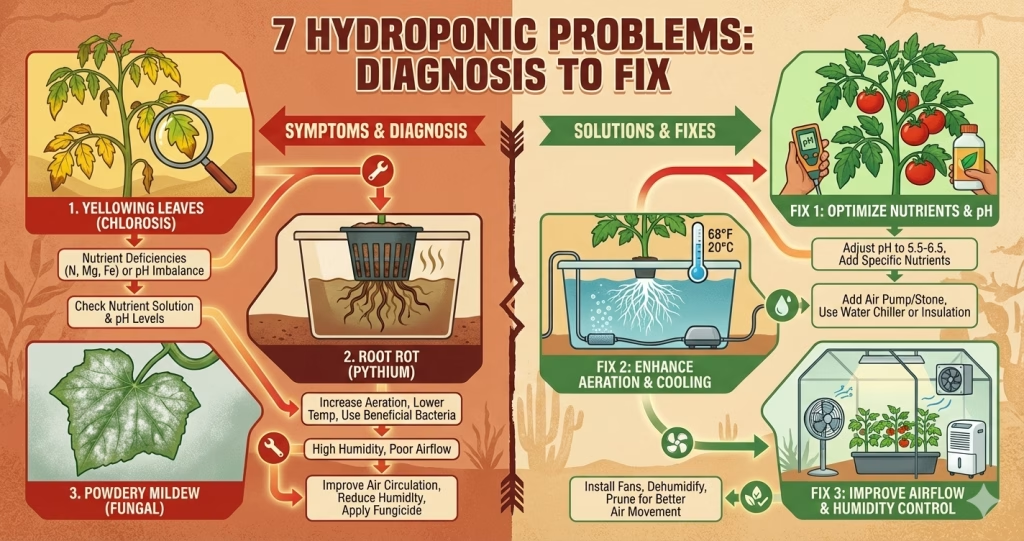
How to Use This Hydroponic Troubleshooting Flowchart
Before diving into the seven problems, here’s how to use this guide:
- Look at your plant symptoms (yellowing, slimy roots, powder on leaves).
- Follow the diagnostic branch for that symptom.
- Match your observations to the root cause.
- Apply the step-by-step fix.
- Use the prevention checklist for your next crop.
The flowchart below maps the seven most common failures and their diagnostic path:

Symptom: Yellowing Leaves
- Check pH first (5.5-6.5 target)
- If pH is off: Nutrient Lockout (fix in 1 day)
- If pH is correct: Check leaf pattern
- Yellowing on old leaves only: Nitrogen Deficiency (fix in 3-5 days)
- Yellowing between veins on new leaves: Iron or Magnesium Deficiency (fix in 5-7 days)
Symptom: Slimy, Brown Roots
- Check dissolved oxygen (DO) level
- If DO is low: Hypoxia / Low Oxygen (fix in 1 day)
- If DO is normal: Inspect for black slime
- Black slime present: Root Rot (Pythium/Phytophthora) (fix in 5-10 days or restart)
Symptom: White Powder on Leaves
- Confirm powdery texture and location (upper and lower surfaces)
- If powder is present: Powdery Mildew (fix in 3-7 days)
- Check humidity and temperature trends
- High humidity swings in Arizona heat: Environmental trigger
Problem 1: Nutrient Lockout (pH Out of Range)
What Causes Nutrient Lockout?
Nutrient lockout happens when pH drifts outside the optimal absorption window, typically 5.5 to 6.5 for most hydroponic crops. Even if your nutrient levels (EC/ppm) look perfect on paper, roots cannot absorb those nutrients when pH is wrong. This is the single most common cause of plant distress in hydroponic systems.
In Arizona, pH swings happen faster due to mineral-rich tap water and temperature fluctuations in summer. A typical scenario: you start with pH 6.2, and by day 3, heat and biological activity push it to 6.8 or higher. Locked-out plants show yellowing, stunted growth, and poor flowering, even though the nutrient tank is full.
How to Identify Nutrient Lockout
- Yellowing or browning leaves, but no specific deficiency pattern.
- Even color loss across the entire plant (not just old leaves).
- Poor growth despite high EC/ppm readings.
- Wilting without obvious root problems.
- pH reading above 6.5 or below 5.3.
The fastest check: Measure pH first, always. If it is outside 5.5 to 6.5, nutrient lockout is your problem.
Step-by-Step Fix for Nutrient Lockout
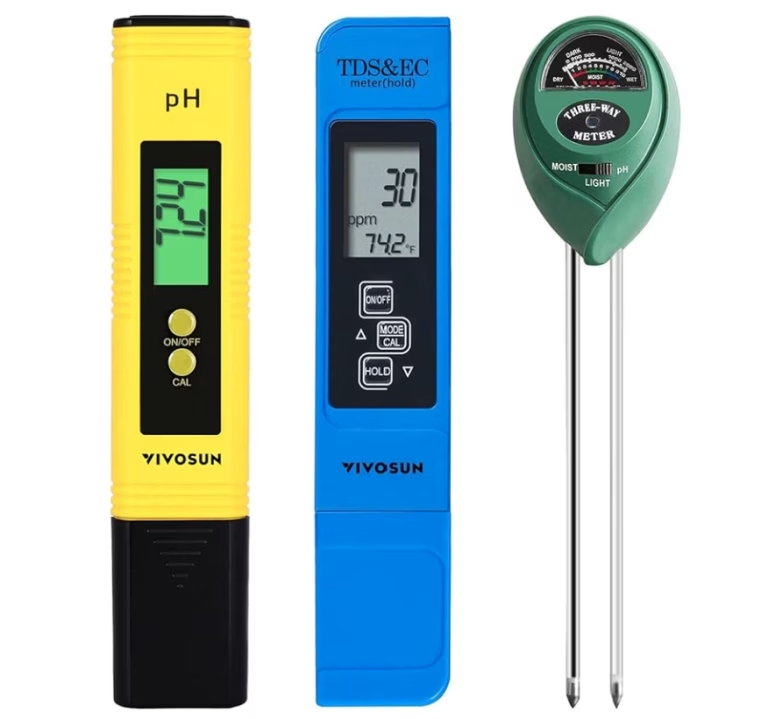
- Measure your pH with a calibrated meter. Use a reliable electronic pH meter (not pH strips, which are inaccurate). If you haven’t calibrated in 2 weeks, recalibrate with pH 7.0 and 4.0 buffers.
- If pH is above 6.5, add pH down. Start with a small dose (e.g., 2-3 mL of pH down per gallon). Mix thoroughly and wait 15 minutes before retesting. Retest every 15 minutes until you reach 6.0 to 6.2. Avoid overcorrecting; it is easier to go up than down.
- If pH is below 5.3, add pH up. Use the same small-dose approach. Aim for 6.0 to 6.2 as your target.
- Monitor for 24 hours. Once you hit target pH, plants should show signs of recovery within 12 to 24 hours (new growth will look healthier, existing leaves may not recover but newer ones will).
- Set up daily pH checks going forward. Log pH, temperature, and EC in a simple spreadsheet. pH typically drifts 0.1 to 0.3 per day, so daily monitoring catches problems early.
Timeline for Recovery
- 1 day: New leaf growth appears greener.
- 3 to 5 days: Yellowing leaves may not recover, but new foliage will be healthy.
- 7 days: Full recovery if you maintain pH consistently.
Prevention Checklist for Next Crop
- Use a reliable electronic pH meter and calibrate every 14 days.
- Test pH daily, especially in the first 2 weeks and during heat spikes.
- Use pH up and down in small doses; avoid dramatic swings.
- Change out your nutrient solution every 3 to 4 weeks to reset pH drift.
- Use filtered or reverse-osmosis water if your tap water has high TDS (total dissolved solids above 150 ppm).
The Complete Guide to Hydroponic pH Management → pH guide
Problem 2: Nitrogen Deficiency
What Causes Nitrogen Deficiency?
Nitrogen is a mobile nutrient, meaning plants can relocate it from old tissue to new growth. This is why nitrogen deficiency always shows up on older leaves first. In hydroponics, nitrogen deficiency happens when:
- Your nutrient solution is mixed at too low a concentration.
- You are using a nutrient formula designed for a different crop type.
- You have not changed your solution in over 4 weeks and nitrogen has been depleted.
- pH is slightly high (above 6.5), which can reduce nitrogen availability even if it is present in the tank.
Leafy greens, herbs, and fruiting plants all need steady nitrogen. Deficiency slows vegetative growth and can trigger early bolting in lettuce and spinach.
How to Identify Nitrogen Deficiency
- Uniform yellowing on the oldest leaves, progressing upward over time.
- Smaller, thin leaves developing as deficiency worsens.
- Purple or reddish stems (in some crops like arugula).
- Stunted growth and reduced leaf area.
- Green veins remain, but the tissue between them turns yellow (later stage).
The key signature: Yellowing starts on the oldest leaves and moves upward. Iron deficiency, by contrast, shows up on new leaves first.
Step-by-Step Fix for Nitrogen Deficiency
- Check your pH first. If pH is above 6.5, correct it to 6.0 to 6.2. This improves nitrogen uptake immediately.
- Measure your current EC/ppm. A reliable TDS or EC meter tells you the total nutrient concentration. Compare to your nutrient bottle’s recommended dose for your crop stage.
- If EC is low, mix a fresh nutrient dose. Follow your nutrient formula’s instructions (e.g., “5 mL per gallon for vegetative stage”). Add only what is needed; do not over-dose. Retest EC after mixing.
- If EC is high but nitrogen is deficient, do a partial water change. Replace 25 to 50% of your tank with fresh water and reapply your base nutrient dose at the recommended strength.
- Monitor new leaf growth. Within 3 to 5 days, newly formed leaves should be darker green and larger. Older yellowed leaves will not recover.
Leaf-Level Data: Nitrogen vs. Iron Deficiency
| Symptom | Nitrogen Deficiency | Iron Deficiency |
|---|---|---|
| First appears on | Oldest leaves | Newest (upper) leaves |
| Pattern | Uniform yellowing | Interveinal (between veins) |
| Vein color | May turn purple or brown | Veins stay bright green |
| Timeline | Visible in 2 weeks | Visible in 1 to 2 weeks |
| Progression | Moves upward | Moves downward then spreads |
Timeline for Recovery
- 3 to 5 days: New leaves emerge with normal green color.
- 7 days: Growth rate returns to normal.
- 14 days: Full recovery if nutrient levels stay balanced.
Prevention Checklist for Next Crop
- Use a complete, balanced nutrient formula matched to your crop type (e.g., vegetative vs. fruiting blend).
- Follow the nutrient dose on the bottle label; more is not better.
- Keep a log of EC readings and nutrient top-ups.
- Change your full solution every 3 to 4 weeks to prevent nutrient lockout and depletion.
- Test pH and EC twice per week during active growth.
Hydroponic Nutrient Guide → The Ultimate Guide to Hydroponic Nutrients: Types, Roles, Application, and Optimization
Problem 3: Iron Deficiency (Young Leaf Chlorosis)
What Causes Iron Deficiency?
Iron is immobile, meaning plants cannot move it from old leaves to new growth. It always shows up on the newest, upper leaves first. In hydroponics, iron deficiency is almost always caused by high pH, not low iron in the tank. When pH exceeds 6.5, iron precipitates (turns into a solid form) and becomes unavailable to roots, even though it is chemically present in the solution.
Arizona’s mineral-rich tap water often has higher pH (7.0 to 7.5), which means you need to actively push your hydroponic solution toward the lower end of the range (5.8 to 6.2) to prevent iron lockout.
How to Identify Iron Deficiency
- Yellowing appears on the newest, youngest leaves at the top of the plant.
- Veins stay bright green; tissue between veins turns bright yellow (interveinal pattern).
- Often looks like a “Christmas tree” pattern (green veins on yellow background).
- Severe deficiency: leaves may turn white or develop brown, dead spots between veins.
- Growth slows, and leaf size shrinks.
The key signature: New leaves yellow while old leaves stay green. This is the opposite of nitrogen deficiency.
Step-by-Step Fix for Iron Deficiency
- Check your pH immediately. Iron deficiency is almost always a pH problem, not an iron shortage. Measure pH; if it is above 6.3, bring it down to 6.0 to 6.2 using pH down.
- Apply pH down in small doses. Add 2 to 3 mL per gallon, wait 15 minutes, retest. Repeat until pH reaches 6.0 to 6.2. Do not overcorrect below 5.8.
- Add iron chelate (DTPA or EDDHA form) as insurance. Even after pH correction, a small iron boost helps recovery. Follow product instructions (typically 1 to 2 mL per 5 gallons). Chelate iron is already in a plant-available form.
- Monitor new growth. Within 5 to 7 days, newly formed leaves should emerge green. Older yellowed leaves will not recover, but the plant should bounce back as new tissue forms.
- Maintain pH in the 6.0 to 6.2 range going forward. This is the sweet spot for iron availability and overall nutrient uptake.
Prevention Checklist for Next Crop
- If using Arizona tap water, start with pH down on day one to establish 6.0 to 6.2 from the beginning.
- Calibrate your pH meter every 2 weeks.
- Monitor pH every morning, especially during the first 3 weeks and any heat event.
- Keep chelate iron on hand (liquid DTPA or EDDHA) for fast recovery.
- Consider a reverse-osmosis (RO) unit if you want more predictable starting water chemistry.
Problem 4: Magnesium Deficiency (Interveinal Yellowing on Older Leaves)
What Causes Magnesium Deficiency?
Magnesium is a mobile nutrient, so it relocates to new growth first, leaving old leaves depleted. Deficiency occurs when:
- Your nutrient formula is low in magnesium (some cheaper formulas are skimpy on micro elements).
- pH is very high (above 7.0), which reduces magnesium uptake.
- You have extremely high potassium or calcium, which can competitively block magnesium absorption.
- Solution has been running for over 4 weeks without a change.
Magnesium is the central atom in chlorophyll, so deficiency directly cuts photosynthetic ability. Plants produce less sugar and show slow growth even before visual symptoms appear.
How to Identify Magnesium Deficiency
- Yellowing appears on older leaves first.
- Veins remain green; yellowing occurs between veins (interveinal pattern).
- Looks like a “Christmas tree” pattern (similar to iron, but on old leaves instead of new ones).
- Symptom appears roughly 2 to 3 weeks into deficiency.
- Over time, the yellowing progresses to brown, dead spots between veins.
The key signature: Interveinal yellowing on old leaves (magnesium is mobile). If yellowing is on new leaves, suspect iron instead.
Step-by-Step Fix for Magnesium Deficiency
- Check your pH. If pH is above 6.5, correct it down to 6.0 to 6.2 using pH down.
- Verify your nutrient formula includes magnesium. Look at the bottle label for Mg content. A complete hydroponic formula should contain 40 to 80 ppm magnesium. If your formula is missing it, switch brands.
- Add magnesium sulfate (Epsom salt) as a fast supplement. Dissolve 1 teaspoon of Epsom salt per 5 gallons of water, stir well, and wait 30 minutes. Test EC; it should rise slightly. This provides 50 to 100 ppm magnesium instantly.
- Do a partial solution change if deficiency is severe. Replace 25 to 50% of the tank with fresh water and remix your base nutrient at full strength. This resets the balance.
- Monitor recovery over 5 to 7 days. New leaves should emerge with normal color. Old yellowed leaves will not recover but will eventually drop.
Timeline for Recovery
- 3 to 5 days: New growth is noticeably greener.
- 7 days: Plant growth rate improves.
- 14 days: Full recovery if you maintain nutrient balance.
Prevention Checklist for Next Crop
- Use a complete nutrient formula with documented magnesium content (40 to 80 ppm).
- Check the label; avoid “budget” formulas that cut corners on micronutrients.
- Keep Epsom salt on hand for fast supplementation.
- Maintain pH in the 6.0 to 6.2 range; high pH reduces magnesium uptake.
- Change your full solution every 3 to 4 weeks.
- Avoid very high potassium doses, which can interfere with magnesium absorption.
The Complete Hydroponic Nutrient Guide → The Ultimate Guide to Hydroponic Nutrients: Types, Roles, Application, and Optimization
Problem 5: Root Rot (Pythium and Phytophthora)
What Causes Root Rot?
Root rot is caused by water-borne pathogens like Pythium and Phytophthora, which thrive in warm, stagnant water with low dissolved oxygen (DO). Root rot is one of the most destructive hydroponic problems because it can kill an entire crop within 5 to 7 days if left unchecked.
Risk factors include:
- Water temperature above 68 degrees Fahrenheit (ideal is 60 to 65 degrees).
- Insufficient aeration or a failed air pump.
- Dead plant material (biofilm) in the tank that feeds pathogens.
- High water recirculation without adequate oxygenation (common in NFT systems if air stone fails).
Arizona’s summer heat is a major trigger. Ambient temperatures of 110+ degrees can push tank water to 75 degrees or higher if you do not actively cool it.
How to Identify Root Rot
- Roots are brown, slimy, and fall apart when gently pulled.
- Strong, foul smell (sulfur or rotten smell) from the tank.
- Plant wilts suddenly despite adequate water and nutrients.
- Base of stem turns mushy or black.
- No white, fuzzy fungal growth on leaves (that would suggest a different fungal disease).
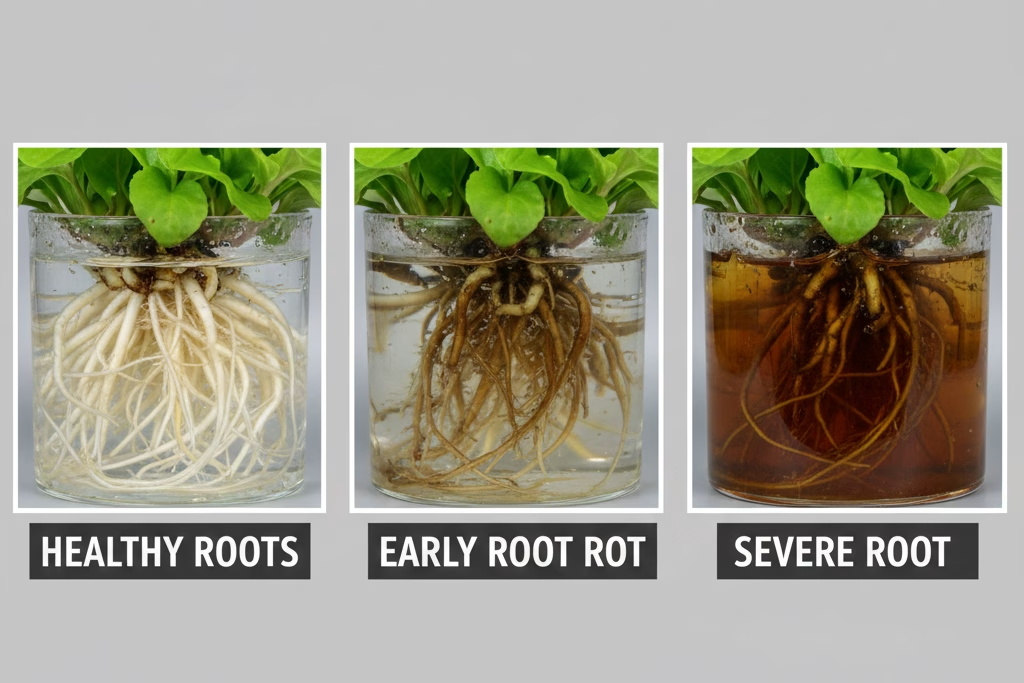
The key signature: Slimy, brown roots that smell bad. Healthy roots are white or light tan and firm to the touch.
Step-by-Step Fix for Root Rot
If caught early (less than 5% of root system affected):
- Lower water temperature immediately. Use an aquarium chiller, add ice packs, or move the system to a cooler location. Target 60 to 65 degrees Fahrenheit. If you cannot cool it, root rot will likely continue despite other fixes.
- Increase dissolved oxygen. Check your air pump; if it is running, make sure the air stone is clean and bubbling vigorously. If the pump has failed, replace it immediately. Add a second air stone if possible.
- Add a beneficial bacteria product. Products like Great White or Hydroguard introduce Bacillus and other beneficial microbes that compete with Pythium. Follow the product’s dose (typically 1 to 2 mL per 5 gallons weekly).
- Do a partial 25% water change. Remove 25% of the old water (which may have high pathogen spores) and replace with fresh, pH-balanced water. Remix your nutrient at full strength.
- Prune out the black/mushy roots. Sterilize your pruners between each cut (dip in rubbing alcohol or bleach solution). Remove only the dead portions; leave white/tan roots intact.
- Monitor daily. Check root color, smell, and plant vigor every morning. If root rot continues to spread after 3 days, move to the “severe case” protocol below.
If root rot is severe (more than 50% of roots affected or multiple plants infected):
- Harvest what you can. Some plants may be salvageable if you cut them quickly and move them to a clean, oxygenated clone system.
- Drain and disinfect the entire system. Remove all water, substrate, and plant debris. Scrub the tank with a 10% bleach solution (1 part bleach to 9 parts water). Rinse thoroughly.
- Replace all tubing, air stones, and pump. These items harbor spores. Do not reuse them.
- Restart with fresh water, new nutrient, and beneficial bacteria. Wait 48 hours before replanting to ensure the tank is fully cycled and clean.
Timeline for Recovery
- If caught early: 5 to 7 days to stabilize, 14 days to resume growth.
- If severe: Total system restart required; expect 2 weeks downtime.
Prevention Checklist for Next Crop
- Install an aquarium chiller or use the “swamp cooler” method (wet towel over the tank + fan) in Arizona summer heat to keep water below 68 degrees Fahrenheit.
- Use two air pumps (one backup) or add a second air stone to ensure redundancy.
- Monitor dissolved oxygen daily; invest in a basic DO meter if you run a large system.
- Change the water every 3 to 4 weeks to dilute accumulated pathogens and biofilm.
- Keep your tank clean; remove any dead plant material immediately.
- Use beneficial bacteria as a preventive (weekly dose of Hydroguard or equivalent).
- Never reuse old tubing or air stones; replace every crop cycle.
Water Temperature Control for Hydroponics: Arizona Edition → cooling guide
Dissolved Oxygen and Hydroponics: Why It Matters and How to Measure It → DO guide
Problem 6: Algae Growth
What Causes Algae?
Algae is not a disease, but it is a serious problem because it:
- Consumes nutrients meant for your plants.
- Blocks light from reaching the nutrient solution.
- Creates a sludgy, clogged system that slows water flow.
- Competes with your plants for resources, reducing growth.
Algae thrives when:
- Sunlight or bright light reaches the nutrient solution.
- Water temperature is warm (65 to 75 degrees).
- Nutrients are abundant.
- Water is not regularly changed.
How to Identify Algae
- Green, brown, or reddish film on the water surface.
- Slimy coating on air stones, tubing, and tank interior.
- Nutrient solution appears cloudy or greenish.
- Clogged tubing or slow water flow despite pumps running normally.
Step-by-Step Fix for Algae
- Block all light from the nutrient tank and lines. Wrap tubing with opaque tape or flex tubing. Use a dark or opaque reservoir. Algae cannot grow without light.
- Lower water temperature to 60 to 65 degrees. Use the same cooling strategies as for root rot (chiller, ice packs, or swamp cooler).
- Clean the system thoroughly. Remove all visible algae from air stones, tubing, and the tank interior. Use a soft brush and warm water, or soak components in a 10% bleach solution for 15 minutes.
- Perform a full water change and remix nutrients. Algae can recolonize from spores in the old water.
- Add an algaecide if needed. Products like Phycomyces or UV sterilizers work, but the best approach is prevention: block light, keep water cool, and change solutions regularly.
Prevention Checklist for Next Crop
- Use an opaque or dark-colored reservoir (never clear plastic).
- Wrap all exposed tubing with opaque tape or use opaque tubing from the start.
- If your grow room has bright LED lights above the tank, shade the water surface with cardboard or a cover.
- Keep water temperature between 60 and 65 degrees Fahrenheit.
- Change the nutrient solution every 3 to 4 weeks.
- Clean the tank, tubing, and air stones every 2 weeks.
Problem 7: Powdery Mildew (Arizona-Specific Challenge)
Why Powdery Mildew is an Arizona Problem
Powdery mildew is the most common fungal issue in Arizona indoor hydroponic gardens because the climate creates a perfect storm:
- Desert air is naturally dry (humidity often 15 to 30%), but plant transpiration creates localized humidity pockets (60 to 80% right at the leaf surface).
- Summer temperature swings (110 degrees Fahrenheit outside, 70 degrees inside with air conditioning) create rapid humidity fluctuations that trigger fungal spore germination.
- The contrast between hot days and cool nights in spring and fall creates condensation risks.
Unlike other molds, powdery mildew does not require standing water. It thrives in the relative humidity created by close leaf spacing and poor air circulation. A dry room with poor airflow is a powdery mildew breeding ground.
How to Identify Powdery Mildew
- White, powdery coating on leaf surfaces (upper and lower).
- Coating looks like flour or talc dusted on the leaves.
- Often starts on lower, shaded leaves or inner canopy areas.
- Affected leaves may develop yellow or brown spots underneath the powder.
- Severe infections: leaves shrivel, growth slows, and mildew spreads to stems and flowers.
Step-by-Step Fix for Powdery Mildew
Mild infection (less than 20% of leaves affected):
- Increase air circulation immediately. Use a fan to create steady, gentle airflow across the canopy. The goal is 1 to 2 meters per second of air movement (strong enough to sway leaves slightly, not blast them). Run the fan for 8 to 12 hours per day.
- Adjust humidity to 55 to 65%. Use a dehumidifier to pull moisture out of the air. This counterintuitively prevents powdery mildew, because spore germination is triggered by rapid humidity changes, not high humidity itself. Stable, moderate humidity is your goal.
- Apply an organic fungicide spray. Options include:
- Sulfur dust or spray (effective, safe for food crops, but reacts poorly with oils above 85 degrees, so apply in the morning or evening).
- Neem oil spray (highly effective; spray in the evening to avoid oil burns in sunlight).
- Baking soda solution (1 tablespoon per gallon of water plus 1 tablespoon horticultural oil; spray foliage thoroughly, including undersides).
- Spray every 7 to 10 days for 3 weeks. Powdery mildew spores germinate in 48 hours, so consistent spraying is crucial. Rotate between two different fungicides to avoid resistance.
- Remove heavily infected leaves manually. If a single leaf is covered in mildew, prune it off. Sterilize your pruners between cuts.
Severe infection (more than 50% of leaves affected or multiple plants infected):
- Isolate infected plants. Move them away from other crops to prevent spore spread.
- Strip all infected leaves. Be aggressive; remove any leaf with visible powder. The plant will regrow healthy foliage.
- Spray with a stronger fungicide. Consider a chemical option like sulfur combined with neem oil, or a copper-based fungicide (follow label directions).
- Improve environment aggressively: Lower humidity to 50 to 60%, increase air circulation to 2 meters per second, and raise temperature slightly (to 70 to 75 degrees) to discourage spore germination.
- Monitor daily. Spray every 3 to 5 days until no new powder appears for 2 weeks.
Real Data: Powdery Mildew Lifecycle
| Stage | Timeframe | Conditions | Action |
|---|---|---|---|
| Spore germination | 6 to 48 hours | High humidity (60%+), moderate temperature (60 to 80 degrees) | Prevent with humidity control + airflow |
| Active growth | Days 2 to 7 | Warm, humid pockets, poor airflow | Apply fungicide spray |
| Spore release | Days 7 to 14 | Dry conditions (50% humidity) | Continue spraying; remove leaves |
| Recovery | Days 14 to 21 | Consistent humidity + airflow + fungicide | Monitor; spray once more after 2 weeks |
Arizona-Specific Prevention Checklist
- Summer strategy: Run a dehumidifier to maintain 50 to 60% relative humidity. Use a ceiling fan or clip fans for 10 to 12 hours per day.
- Spring/Fall strategy: Monitor humidity closely during temperature swings. Evening condensation is a red flag; increase airflow and reduce humidity.
- Water scheduling: Water in the morning so leaves dry quickly. Never water in the evening or night, which traps humidity.
- Spacing: Space plants so you can see light through the canopy. Dense, crowded plants = humidity pockets = powdery mildew risk.
- Varieties: Some crops are more susceptible than others. Basil, squash, and cucumbers are high-risk; lettuce and spinach are low-risk.
- Organic arsenal: Keep sulfur dust, neem oil, and baking soda solution on hand. Rotate applications to prevent fungicide resistance.
- Preventive spray (monthly): Even without visible mildew, spray a baking soda solution once monthly during high-risk seasons (spring and fall).
Humidity and Temperature Control for Hydroponics → environment guide
Frequently Asked Questions
Can I save my plants after root rot starts?
Yes, if caught early. If less than 20% of roots are affected, lower water temperature, increase aeration, and add beneficial bacteria. Recovery takes 7 to 14 days. If more than 50% of roots are rotted or smell foul, you will likely need to restart the system.
How fast does pH adjustment work?
Same day. Plants show recovery within 12 to 24 hours once pH reaches the target range (5.8 to 6.3). New leaf growth will be noticeably healthier. However, yellowed old leaves will not recover; only new foliage will be green.
What is a normal EC/PPM for hydroponic lettuce and herbs?
- Leafy greens (lettuce, spinach, arugula): 1.0 to 1.4 EC (500 to 700 ppm)
- Herbs (basil, mint, parsley): 1.2 to 1.6 EC (600 to 800 ppm)
- Fruiting crops (tomatoes, peppers): 1.6 to 2.0 EC (800 to 1000 ppm)
Always follow your nutrient bottle’s recommendations; these are typical ranges.
Why is my system getting algae if the tank is dark?
Algae spores were already in your water or air. If tubing, air stones, or water surfaces are exposed to any light (even from LED grow lights 12 inches above the tank), algae will grow. Make sure all surfaces in contact with nutrient solution are opaque. Also, check for white or clear air lines; those are light highways for algae spores.
Is powdery mildew dangerous to eat?
No, powdery mildew is not toxic to humans. However, it is unsightly and reduces nutrient uptake, so it lowers plant quality. Always wash harvested produce thoroughly, and prune heavily infected leaves before harvest.
How do I know if my nutrient formula is complete?
Check the label for nitrogen (N), phosphorus (P), potassium (K), magnesium (Mg), calcium (Ca), iron (Fe), boron (B), zinc (Zn), manganese (Mn), and molybdenum (Mo). A complete formula should list all of these. If magnesium, iron, or other micronutrients are missing, the formula is incomplete and will cause deficiencies.
Can I use the same nutrient solution for 6 weeks without changing it?
Not recommended. After 3 to 4 weeks, nutrient ratios shift as plants consume some elements faster than others. Trace elements like iron drop first. Changing your solution every 3 to 4 weeks prevents cumulative lockout and deficiency issues. For long-term crops (tomatoes, peppers), change every 4 weeks. For fast crops (lettuce, herbs), change every 3 weeks.
What is the best water temperature for hydroponics?
60 to 65 degrees Fahrenheit (15 to 18 degrees Celsius). This range maximizes dissolved oxygen, minimizes root rot risk, and supports most crops. Above 70 degrees, oxygen levels drop and pathogens multiply faster. Below 50 degrees, nutrient uptake slows.
How do I cool my hydroponic tank in Arizona summer?
Best options:
- Use an aquarium chiller (most reliable, $200 to $500).
- Build a “swamp cooler” with wet towels or burlap over the tank and a clip fan (budget option, 5 to 10 degrees of cooling).
- Relocate the reservoir to a basement or shaded area away from direct heat.
- Add frozen water bottles daily (manual but effective for small systems).
How-To Section: Complete 7-Step Hydroponic System Health Checkup
Goal: Perform a comprehensive diagnostic to catch all seven problems before they escalate.
Time required: 15 to 20 minutes per week.
Tools and materials needed:
- Calibrated pH meter (electronic preferred).
- EC or TDS meter.
- Thermometer or temperature gauge (or aquarium thermometer).
- Small white bowl or plate (to inspect leaf underside and roots).
- Notebook or spreadsheet for logging.
- Flashlight.
- Clean pruners and rubbing alcohol.
Step 1: Check Reservoir Water Temperature
Use your thermometer to measure water temperature in the tank. Record it in your log. If temperature is above 70 degrees, initiate cooling today (chiller, ice packs, or swamp cooler). If above 75 degrees, your root rot risk is very high.
Step 2: Measure and Log pH
Use your calibrated pH meter to test the solution. Record pH. If pH is outside 5.8 to 6.3, adjust immediately using pH up or pH down in small doses. Retesting every 15 minutes until in range.
Step 3: Measure and Log EC/PPM
Use your EC or TDS meter to test nutrient concentration. Record the reading. Compare to your nutrient formula’s recommended dose. If EC is low, add nutrients. If EC is high, do a partial water change (25% old water removed and replaced with fresh water).
Step 4: Visually Inspect All Leaves
Walk through your garden and examine the top and underside of 3 to 5 leaves at different plant heights.
- Healthy leaves: Even green color, no powder, no spots, no yellowing.
- Problem leaves: Yellowing (check which leaves: old or new?), powder (powdery mildew), brown spots (nutrient deficiency or fungal infection), wilting (underwatering or root problems).
Record which plants show problems and the symptom type. Use the flowchart above to diagnose.
Step 5: Inspect Roots and Tank Base
Turn off the pump and look into the reservoir or access the root zone. Use a flashlight to see clearly.
- Healthy roots: White or light tan, firm, pleasant smell.
- Problem roots: Brown or black, slimy, mushy, foul smell (root rot), or excessive algae buildup.
If roots look good, record “healthy.” If you see slime, brown color, or smell, initiate root rot protocol immediately.
Step 6: Check Air Pump and Bubbles
Turn the pump back on. Look for vigorous bubbling in the tank or nutrient lines. If bubbles are slow, weak, or nonexistent, the pump may be clogged or failing. Clean the air stone (soak in 10% bleach for 15 minutes, then rinse). If bubbles do not improve, replace the pump.
Step 7: Log Findings and Plan Next Actions
Write down:
- pH, EC, water temperature.
- Leaf health (any problems noted?).
- Root condition.
- Air pump status.
- Any fixes applied today.
- Date of last solution change.
- Next maintenance date.
Use this log to spot trends. If pH drifts 0.3 per day, you know something is eating nitrogen or consuming CO2 (normal, but monitor closely). If temperature creeps up every afternoon, you need active cooling.
Perform this checkup once per week, or twice per week during the first 4 weeks of a crop.
Author Bio
I am a Phoenix, Arizona-based hydroponics specialist and home grower. My work focuses on accessible, practical solutions for apartment gardeners, balcony farmers, and hobbyists navigating the unique challenges of Arizona summers and low humidity. From managing water temperature in 110-degree heat to preventing powdery mildew in temperature-swinging seasons, I have tested every problem-solution pair covered in this guide in real systems. I believe in transparent, evidence-based growing—no fluff, no hype, just what works.
Share this:

Discover more from Soil Free Harvest
Subscribe to get the latest posts sent to your email.








2 Comments