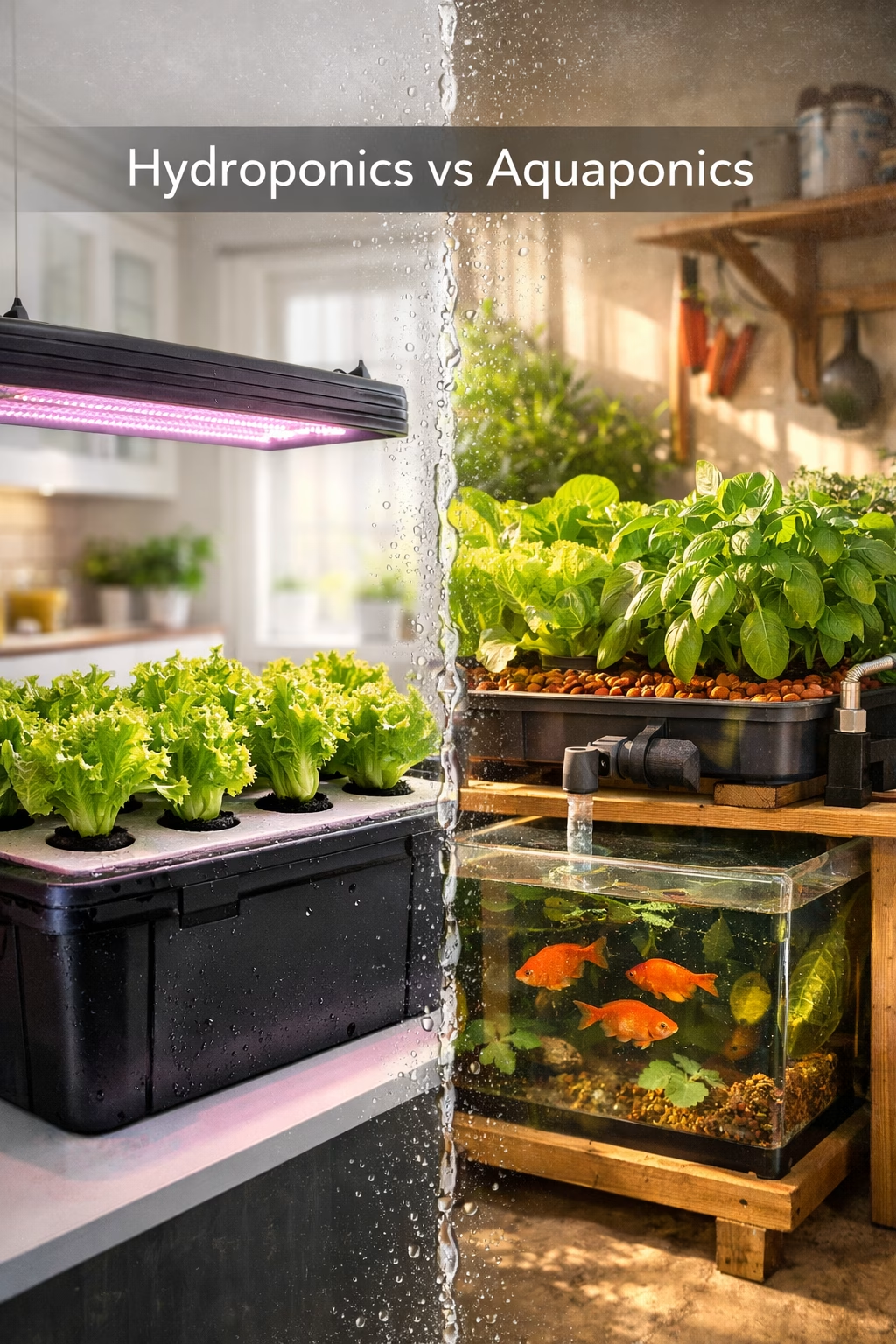
Hydroponics vs Aquaponics: Water, Nutrients, and Complexity for Home Growers
This article walks through the nuances of Hydroponics vs Aquaponics. Hydroponics is usually the better choice for most home and apartment growers because it uses very little water, gives predictable nutrient control, and is simpler to learn than aquaponics. Aquaponics shines when you also want to raise fish and build a mini ecosystem, but it demands more equipment, a longer startup period, and tighter management of water quality for both plants and fish.
TL;DR: Both systems are highly water efficient, but hydroponics is easier, cheaper, and more predictable for leafy greens and herbs, while aquaponics is more complex and better suited to hobbyists who are excited about fish, bacteria, and running a living ecosystem.
Affiliate Disclosure: This article contains affiliate links. If you purchase through these links, soilfreeharvest.com may earn a small commission at no extra cost to you.
What is hydroponics in simple terms?
Hydroponics is the practice of growing plants without soil, using a water based nutrient solution and often an inert growing medium like coco coir, rockwool, or clay pebbles. The grower supplies all essential macro and micronutrients through that solution instead of relying on soil fertility.
In a home setup, roots sit in or above nutrient rich water while air pumps, timers, and lights (for indoor systems) create a controlled environment. Because conditions are controlled, hydroponics can grow plants up to about 40 to 50 percent faster and yield roughly 20 to 25 percent more per square meter than soil when properly managed.
Hydroponics beginner guide → How to Plan a Small Indoor Hydroponic Farm: Complete Beginner Guide (2026)
How does a typical hydroponic system work?
In most hydroponic systems, a reservoir holds water mixed with concentrated nutrient salts that provide nitrogen, phosphorus, potassium, calcium, magnesium, sulfur, and trace elements. A pump circulates this solution past plant roots or keeps it aerated so roots can access both oxygen and nutrients.
You monitor two key metrics: pH and electrical conductivity (EC). Most hydroponic vegetables and herbs prefer a slightly acidic pH between about 5.5 and 6.5, and leafy greens often thrive at EC values around 0.8 to 1.8 mS/cm depending on species and growth stage.
What hydroponic system types are common for home growers?
Common home friendly hydroponic systems include:
- Deep Water Culture (DWC): Plants sit in net pots over a deep reservoir while an air stone oxygenates the water below.
- Nutrient Film Technique (NFT): A thin film of nutrient solution flows through shallow channels, constantly passing over bare roots.
- Ebb and Flow (flood and drain): A timer periodically floods a media filled bed with nutrient solution, then drains it back to the reservoir.
- Wick and Kratky systems: Passive systems that use wicks or static solution levels with no pumps, best for small, low demand setups.
Deep water culture guide → Build a 5 Gallon Bucket DWC System for Under $30: A Budget DIY Hydroponics Guide
Hydroponic system types → Comparing Hydroponic System Types for Home Growers
Which plants grow best in hydroponics?
Hydroponics is ideal for fast growing leafy greens and herbs such as lettuce, basil, kale, cilantro, and spinach, which all fit comfortably in typical pH and EC ranges. Many fruiting crops like tomatoes, peppers, and cucumbers also do well, but they generally need higher EC levels, stronger lighting, and larger root zones than a simple countertop system.
For small apartments or grow tents, focusing on lettuce, leafy greens, and herbs usually gives the fastest harvest cycles and the most forgiving learning curve.
Best hydroponic greens → Best Types of Lettuce to Grow Indoors Using Hydroponics
What is aquaponics in simple terms?
Aquaponics combines aquaculture (raising fish) with hydroponics so that fish waste becomes plant fertilizer and plants help clean the water. Fish produce ammonia rich waste that is converted by beneficial bacteria into nitrate, which is a plant available form of nitrogen.
Water cycles continuously from the fish tank to a biofilter and plant beds, then back to the tank. In a healthy system, you harvest both vegetables and fish while adding only fish feed and occasional supplements like iron or potassium.
How does an aquaponic system work day to day?
An aquaponic loop usually has four major components: a fish tank, a solids filter, a biofilter where nitrifying bacteria live, and a plant growing area using media beds, rafts, or towers. Fish are fed regularly, producing solid waste and ammonia that move into filters and then into the biofilter where bacteria convert ammonia to nitrite and then nitrate.
The plant beds receive this nitrate rich water, remove nutrients, and return clearer water to the fish tank. Because the system must support fish, plants, and bacteria, aquaponic pH is usually kept in a compromise range of roughly 6.5 to 7.0 or 6.8 to 7.2.
Which plants and fish are best for aquaponics?
Most leafy greens, herbs, and some fruiting crops grow well in aquaponics as long as nutrient levels are high enough and temperatures suit both plants and fish. Tilapia is a classic warm water choice, but many systems also use species like perch, catfish, or goldfish depending on climate and whether you plan to eat the fish.
Beginners usually get the most stable results with hardy greens and herbs plus hardy fish like tilapia or goldfish rather than sensitive or high value species.
How do hydroponics and aquaponics compare on water use?
Both hydroponics and aquaponics can use dramatically less water than traditional soil gardening, especially in arid regions. Modern hydroponic systems often use about 70 to 90 percent less water than soil based growing because water is recirculated instead of lost to runoff and deep drainage.
Peer reviewed work on controlled environment lettuce production has shown that hydroponic systems in places like Arizona can reduce water use per kilogram of lettuce by more than tenfold compared to open field farms. Aquaponics is similarly efficient; commercial systems using vertical towers have reported daily water losses as low as roughly 1.5 percent of system volume, mostly from plant transpiration.
In practice, for a home grower in a hot, dry climate like Phoenix, a small closed loop hydroponic or aquaponic system can grow lettuce heads with a fraction of the water a soil bed would need under the same sun. The main difference is that hydroponics sometimes requires periodic reservoir dumping to remove built up salts, while aquaponics typically only loses water through evaporation, transpiration, and occasional top ups.
Water saving hydroponics → Water-Efficient Hydroponics: Preparing for Drought and Water Shortages
How do nutrients work in hydroponics vs aquaponics?
Where do hydroponic nutrients come from?
In hydroponics, you add nutrient salts directly to the reservoir, either as dry powders or liquid concentrates. These mixes are formulated to include all essential elements plants need, and you control concentration by adjusting EC to match the crop and growth stage.
You also use pH up or pH down solutions as needed to keep the nutrient solution in the target range, which for most vegetables is roughly 5.5 to 6.5. If you follow a reputable nutrient schedule and monitor pH and EC, nutrient management is repeatable and highly predictable.
hydroponic nutrient schedule → The Ultimate Guide to Hydroponic Nutrients: Types, Roles, Application, and Optimization
Where do aquaponic nutrients come from?
In aquaponics, most nutrients originate from fish feed and the resulting fish waste rather than from bottled fertilizer. Fish excrete nitrogen mostly as ammonia, which bacteria convert into nitrate; plants then absorb nitrate and other dissolved nutrients.
However, fish feed alone often does not supply enough potassium, calcium, and iron in the right forms for heavy feeding crops, so many growers add small amounts of supplemental minerals or chelated iron. Balancing nutrient density is trickier because you cannot simply crank up EC without affecting fish health, and the ideal pH for nitrification and fish does not perfectly match the ideal pH for many vegetables.
Which system is more complex for beginners?
Hydroponics asks you to manage plants and water chemistry but not live animals, so the learning curve is mostly about pH, EC, light, and temperature. You can start with a simple DWC bucket or tote, a small submersible pump or air pump, and a basic nutrient kit, and be harvesting lettuce in 4 to 6 weeks.
Aquaponics adds fish health, biofilter cycling, and solids management on top of everything hydroponics requires. You need to cycle the system for weeks to establish nitrifying bacteria, monitor ammonia, nitrite, and nitrate, and keep pH in a compromise range that keeps fish, bacteria, and plants all reasonably happy.
If a hydroponic reservoir drifts out of range, plants may suffer but you can usually recover by dumping and remixing; if an aquaponic system crashes, you can lose fish, plants, and bacteria at the same time. This extra complexity is why most extension services recommend hydroponics over aquaponics for absolute beginners who just want salad and herbs.
Side by side comparison: hydroponics vs aquaponics
How do water, nutrients, and complexity stack up?
| Feature | Hydroponics | Aquaponics |
|---|---|---|
| Water use vs soil | Typically uses about 70 to 90 percent less water than soil gardening by recirculating solution | Also highly water efficient, with some systems losing only about 1.5 to 7 percent of water per day mainly from plant transpiration and minor leaks |
| Nutrient source | Bottled or dry salt nutrients give full control over N, P, K, and micronutrients | Fish feed and fish waste provide most nutrients, sometimes supplemented with iron, potassium, or calcium |
| pH target | Slightly acidic, often 5.5 to 6.5 for most crops | Compromise near neutral, roughly 6.5 to 7.0 or 6.8 to 7.2 for fish, plants, and bacteria |
| Complexity | Moderate: manage pH, EC, light, and temperature, but no animals | High: manage fish health, biofilter cycling, solids, and plant nutrition together |
| Startup time | Can be planted as soon as the system is assembled and solution mixed | Requires weeks to cycle bacteria before fully stocking fish and planting heavily |
| Best suited for | Small apartments, hobby grow tents, leafy greens, herbs, and high density production | Enthusiasts who enjoy fish, want a semi closed loop ecosystem, and have more space and time |
| Typical startup cost (small DIY) | Lower to moderate, especially for simple DWC or Kratky builds with basic pumps and lights | Higher, because of fish tanks, filters, backup aeration, and more plumbing |
Hydroponics vs soil → Hydroponics vs Traditional Gardening: Pros and Cons
What equipment do you need for home hydroponics?
A basic indoor hydroponic system for leafy greens usually needs:
- Reservoir: Food grade tote or bucket to hold nutrient solution.
- Net pots and lids or raft: To support plants and allow roots to hang in solution.
- Growing medium: Options like rockwool cubes, coco, or clay pebbles for seedlings.
- Air pump and air stone or circulation pump: To keep oxygen levels high at the roots.
- LED grow light (if indoors): Full spectrum fixture sized for your grow area.
- pH and EC meter plus pH adjusters: To monitor and tweak solution chemistry.
- Hydroponic nutrient concentrate: Balanced veg formula appropriate for greens and herbs.
Once dialed in, home hydroponic systems often run with only weekly reservoir checks, top ups, and pH or EC tweaks.
Hydroponic equipment checklist → Hydroponics vs Traditional Gardening: Pros and Cons
What equipment do you need for home aquaponics?
A small home aquaponic system typically requires everything a hydroponic system uses plus aquaculture gear:
- Fish tank: Appropriately sized tank or IBC tote for your target fish stocking density.
- Mechanical filter: To capture solids before they clog biofilters or plant beds.
- Biofilter: Media or dedicated filter where nitrifying bacteria colonize and convert ammonia to nitrate.
- Plant grow beds or rafts: Media beds, deep water rafts, or vertical towers sized to match fish waste output.
- Continuous aeration and circulation pumps: Redundant air pumps and water pumps to protect fish if one fails.
- Test kits: Ammonia, nitrite, nitrate, and pH tests to track cycling and ongoing stability.
- Fish feed and occasional supplements: Quality feed plus minerals like chelated iron or potassium when needed.
Because fish are sensitive to outages, many aquaponic growers also use backup power or battery air pumps, which adds to both cost and complexity.
Aquaponics equipment list → Beginner Aquaponics Equipment Checklist: Essential Gear for Your First Home System
How to build a simple DWC hydroponic tote system at home
Title: Simple DWC Lettuce Tote for Indoor Growing
Short description:
This how to shows you how to build a beginner friendly deep water culture tote that can grow several heads of lettuce or herbs using minimal space and water. It is a good starting point before tackling more complex hydroponic or aquaponic systems.
Materials and tools:
- 10 to 20 gallon food grade plastic tote with lid
- 6 to 8 net pots (2 to 3 inches diameter)
- Drill with hole saw sized to your net pots
- Air pump, airline tubing, and 1 to 2 air stones
- Hydroponic nutrient solution for leafy greens
- pH meter and pH up / pH down
- EC or TDS meter (optional but recommended)
- Rockwool or similar starter cubes and seeds
I have an Amazon Shopping list of some of my favorites here: Essential Hydroponics Tools
Step 1: Mark and drill the lid
Use a marker to evenly space 6 to 8 circles on the tote lid, leaving at least a couple of inches between holes so plants have room. Drill holes with a hole saw that matches your net pot diameter so they sit snugly without falling through.
Step 2: Install the air stones and pump
Place one or two air stones on the bottom of the tote and run airline tubing up and out one corner of the lid. Connect the tubing to an air pump located above water level to avoid back siphoning, and check that the stones produce strong bubbling.
Step 3: Fill and mix the nutrient solution
Fill the tote with clean water, leaving a couple of inches of headspace below the lid, and add nutrient concentrate according to the label for leafy greens. Stir well, then measure EC to confirm you are within roughly 0.8 to 1.2 mS/cm for lettuce, adjusting by adding more nutrients or more water.
Step 4: Adjust pH into the target range
Use your pH meter to check solution pH and slowly add small amounts of pH down or pH up until readings fall between about 5.5 and 6.0. In my own DWC setups, keeping pH near the lower end of this range in warm conditions has helped prevent nutrient lockout and tip burn.
Step 5: Start seeds in cubes
Moisten rockwool or starter cubes with plain water that has been adjusted to the same pH range and tuck seeds for lettuce or herbs into the top of each cube. Keep cubes in a tray with gentle light until seedlings have several true leaves and roots emerging from the bottom.
Starting seeds for hydroponics → Hydroponic Seed Starting Guide
Step 6: Transplant seedlings into the tote
Insert each cube into a net pot and place the pots into the lid holes, adjusting solution level so the bottom of each cube just barely touches the water surface. This lets roots find the water while the top of the cube stays airy and less prone to damping off.
Step 7: Provide light and airflow
If you are indoors, hang an LED grow light 12 to 18 inches above the canopy, following manufacturer recommendations for intensity and runtime. Add a small fan to move air across the leaves, which helps prevent disease and improves nutrient transport, especially in warmer rooms.
Step 8: Maintain water level, EC, and pH
Top up the tote with nutrient solution or plain water as plants drink and EC drifts, targeting that same 0.8 to 1.2 mS/cm window for lettuce. Check pH every couple of days, keeping it between about 5.5 and 6.5, and expect to harvest crisp heads or cut and come again lettuce in roughly 4 to 6 weeks depending on variety and temperature.
What problems should you expect and how do you troubleshoot them?
Common hydroponic issues
- pH drift: If pH rises above roughly 6.5, you may see yellowing leaves from nutrient lockout; gently bring it back down with pH down rather than making big swings.
- High EC and tip burn: Lettuce edges turning brown usually indicates EC is too high, especially in hot conditions, so dilute the solution and increase airflow.
- Root issues: Brown or slimy roots often mean low oxygen or high temperatures; add more aeration and keep nutrient temperatures in a comfortable range similar to room temperature.
Hydroponic troubleshooting → Why Your Hydroponic System Failed: A Troubleshooting Flowchart for 7 Critical Problems
Common aquaponic issues
- Ammonia or nitrite spikes: During cycling or after overfeeding, toxic levels can rise quickly, stressing or killing fish; partial water changes and reduced feeding help stabilize the system.
- pH drift down over time: As bacteria convert ammonia, they produce acids that slowly lower pH, so aquaponic systems often need regular additions of buffers like potassium carbonate to stay near 6.8 to 7.2.
- Nutrient deficiencies: Because pH is higher than typical hydroponic targets, elements like iron may be less available, leading to yellowing between leaf veins and requiring chelated iron supplements.
Aquaponic troubleshooting → Aquaponics Maintenance and Troubleshooting Checklist
How should you choose between hydroponics and aquaponics?
If your primary goal is reliable salads and herbs in a small space with predictable results, hydroponics is usually the better starting point. It offers strong water savings, clear nutrient recipes, and faster setup with less risk from power outages or chemistry mistakes.
If you love the idea of raising fish, building a visible nitrogen cycle, and do not mind more testing and tinkering, aquaponics can be a rewarding hobby that yields both vegetables and fish. It fits best in garages, backyards, or larger indoor spaces where you have room for tanks and filters and where noise from air and water pumps is acceptable.
Many growers start with a simple DWC or NFT hydroponic system to master pH, EC, and plant care, then graduate into aquaponics once they are comfortable managing water quality and daily checks.
FAQ: Hydroponics vs aquaponics for home growers
Is hydroponics cheaper than aquaponics to start at home?
For most home setups, hydroponics is cheaper because you do not need fish tanks, biofilters, or backup aeration for livestock. A simple DWC tote or small kit with nutrients and a light can be built for far less than a comparable aquaponic system with adequate fish volume and filtration.
Which system uses less water, hydroponics or aquaponics?
Both systems are extremely water efficient compared to soil gardening, often cutting water use by 70 to more than 90 percent. Aquaponic systems tend to discharge even less water because they rarely dump and remix entire reservoirs, though real world differences at home scale are small if your hydro system recirculates.
Which is easier for a beginner: hydroponics or aquaponics?
Hydroponics is generally easier for beginners because you only manage plants and nutrient solution, not fish and bacterial cycling. Aquaponics adds more variables and more things that can go wrong, so it better suits growers who enjoy extra monitoring and experimentation.
How long does it take to see results with hydroponics vs aquaponics?
In hydroponics, you can plant immediately after mixing nutrients and adjusting pH, and many leafy greens are harvestable within about 4 to 6 weeks. Aquaponics usually needs several weeks to cycle the biofilter before it fully supports fish and heavy planting, so the total time from setup to first big harvest is longer.
Are hydroponic nutrients safe compared to aquaponic fish based nutrients?
Hydroponic nutrients are concentrated mineral salts similar to what plants would eventually absorb from soil; when mixed correctly, they are safe for plants and commonly used in commercial food production. Aquaponic nutrients come from fish feed and waste, which is also widely used in commercial systems, but you must maintain good filtration and water quality to keep both fish and plants healthy.
Do plants taste different from hydroponic vs aquaponic systems?
Some tasters report slightly different flavor profiles between hydroponic, aquaponic, and soil grown produce, but controlled studies often show that nutrient balance, variety, and harvest timing matter more than the system type alone. Many commercial growers choose hydroponics for consistency and aquaponics for marketing the ecosystem story rather than for dramatic taste differences.
Is aquaponics more sustainable than hydroponics?
Aquaponics can be more circular because fish waste is repurposed as fertilizer and water is recycled through a living ecosystem. Hydroponics can also be sustainable when it recirculates water efficiently and uses energy smartly, especially in regions where water is scarce and food must be grown close to cities.
Can I run aquaponics in a small apartment?
Technically yes, but it is challenging due to tank size, equipment noise, and the need to manage humidity and potential spills around fish tanks. Most apartment dwellers find that compact hydroponic systems are easier to live with and scale, while aquaponics fits better in balconies, garages, or backyards.
What happens in a power outage for each system?
In hydroponics, a short outage mainly reduces aeration or flow and can be tolerated for some time if plants stay moist, though extended outages may damage roots. In aquaponics, fish can die quickly without aeration or circulation, so battery backup or contingency plans are much more important.
Author note
I have grown hydroponic greens and herbs for years in both a hot, dry Phoenix apartment and in cooler indoor setups in Central Michigan, where winter humidity and low light create different challenges. In Phoenix I relied on closed loop DWC and NFT systems to stretch every gallon of water during triple digit summers, while in Michigan my focus has shifted to stable temperatures and dialing in LED lighting for year round salads. Across both climates, I have tested simple hydroponic builds first and then layered in small aquaponic experiments, which has reinforced how much easier it is for most home growers to start with hydroponics and graduate to aquaponics once they are comfortable managing pH, EC, and daily checks.
Share this:

Discover more from Soil Free Harvest
Subscribe to get the latest posts sent to your email.






2 Comments