Passive Hydroponic Systems: A Practical Guide for Home Growers
Passive hydroponic systems let you grow plants in nutrient solution without pumps, air stones, or recirculating water. In most home setups, they work by giving roots access to water, nutrients, and an air gap, which makes them one of the simplest ways to start hydroponics at home.
TL;DR: Passive hydroponics is low cost, quiet, and beginner friendly, especially for lettuce, basil, and other fast-growing leafy crops. It is less ideal for large, thirsty, or long-season fruiting plants unless the reservoir is much larger and the setup is managed carefully.
What is a passive hydroponic system?
A passive hydroponic system grows plants without active pumping or constant circulation. Instead, it relies on capillary action, a wick, or a standing nutrient reservoir that roots can access over time.
For most home growers, the best-known example is the Kratky method. In a Kratky setup, the plant starts with roots touching the nutrient solution, then develops an air root zone as the water level drops naturally.
Kratky method explained → The Complete Guide to Kratky Hydroponic Method: Build Your Own DIY Passive Growing System
How is passive hydroponics different from active systems?
Active systems use pumps, timers, or recirculation to move oxygenated nutrient solution around the root zone. Passive systems do not, so they are quieter, cheaper, and simpler, but they also give you less control over oxygen, water movement, and nutrient refresh.
That tradeoff matters most when crop size increases. Leafy greens and herbs usually handle passive setups well, while tomatoes, cucumbers, and other heavy feeders often need larger reservoirs and tighter monitoring to perform consistently.
How do passive hydroponic systems work?
The core idea is simple: roots need water, nutrients, and oxygen. Passive systems provide water and dissolved fertilizer from a reservoir, while oxygen comes from the air gap above the liquid or from the porous medium around the root zone.
In a passive deep water style container, the net pot is only partly submerged at the beginning. As the plant drinks, the solution level drops and creates more air space, which helps roots breathe while lower roots keep feeding from the reservoir.
What are the main passive system types?
- Kratky method: A non-circulating reservoir with a net pot in the lid; the simplest option for lettuce and herbs.
- Wick system: A fabric or rope wick pulls nutrient solution from a reservoir into the growing medium by capillary action.
- Passive self-watering containers: Similar concept, often using a media bed and lower reservoir, useful for ornamental plants and some edible crops.
For home growers, Kratky is usually the easiest place to start because there are fewer parts to fail. Wick systems can be useful, but they may struggle to move enough moisture for larger, faster-growing plants.
Wick hydroponic systems → Hydroponic Wick System Full Guide
DWC vs Kratky → Kratky Method vs Deep Water Culture: Which Is Better?
Why do home growers like passive hydroponics?
Passive systems appeal to beginners because they reduce both cost and complexity. You can build one from an opaque tote, bucket, jar, or food-safe container with a lid, plus net cups, growing media, water, and nutrients.
They also fit small-space growing well. Apartment gardeners and hobbyists often choose passive setups because they are quiet, compact, and easy to place near a sunny window or under a basic grow light.
What are the biggest benefits?
- Low startup cost compared with pumped systems.
- No electricity required for the reservoir itself in most basic builds.
- Minimal moving parts, so less day-to-day mechanical troubleshooting.
- Good entry point for learning pH, nutrient mixing, and reservoir management.
- Great for small batches of greens and herbs in homes, classrooms, and balconies.
In practical use, passive systems are often the easiest way to show a new grower how hydroponics works. They strip the method down to the essentials, which makes plant response easier to observe and understand.
What are the drawbacks of passive hydroponics?
The biggest limitation is oxygen management. Because the nutrient solution is not being actively aerated, root health depends heavily on the air gap, water level, temperature, sanitation, and crop choice.
Passive setups are also less forgiving when you choose the wrong plant or too small a reservoir. Fast, leafy crops do well, but large fruiting crops can outgrow the water supply or create unstable nutrient conditions if the container is undersized.
Common disadvantages to plan for
| Issue | Why it happens | What it looks like |
|---|---|---|
| Root rot risk | Low oxygen and pathogen pressure increase stress on roots | Brown, slimy roots; drooping plants |
| Algae growth | Light reaches the nutrient solution | Green water, slippery surfaces |
| Nutrient drift | Water level falls and concentration changes over time | Tip burn, pale leaves, stalled growth |
| Crop mismatch | Heavy feeders need more water and nutrients than small passive systems provide | Small fruit, blossom drop, rapid reservoir depletion |
From experience with low-tech indoor setups, the biggest mistake is trying to force a passive container to behave like an active DWC bucket. Passive systems can be extremely productive, but only when the plant size, reservoir volume, and environment match the method.
Preventing root rot in hydroponics → How to Prevent & Fix Root Rot in Hydroponics (2026 Guide)
Hydroponic algae control → Algae, Root Rot, and Clogs: The Holy Trinity of Hydroponic Problems
Which plants grow best in passive hydroponic systems?
Passive hydroponics is best for fast-growing, compact crops with moderate nutrient demand. Lettuce, bok choy, arugula, basil, parsley, mustard greens, chard, and similar leafy or herb crops are common winners.
These plants usually finish before the reservoir becomes hard to manage. Lettuce often reaches harvest in about 5 to 6 weeks from transplant, and many growers begin picking baby leaves around week 3 to 4 depending on light and variety.
Best crops for beginners
- Leaf lettuce and romaine
- Basil and parsley
- Bok choy, mustard greens, and arugula
- Small herbs in jar-sized or compact containers
Crops that are possible but trickier
- Tomatoes
- Cucumbers
- Peppers
- Strawberries
These larger crops are usually better in active systems unless you build around their needs. A five-gallon bucket or larger reservoir may be necessary for tomatoes and cucumbers, while a single lettuce can be grown in roughly a one-gallon container in a classic small Kratky setup.
What equipment do you need?
A simple passive system can be built with a short list of parts. The exact container size depends on crop size, but the basic function stays the same.
Core materials
- Opaque container or bucket with lid
- Net cups or net pots, often 2-inch for small greens
- Growing medium such as perlite, clay pebbles, coco coir, vermiculite, or rockwool for support
- Hydroponic nutrients with macro and micronutrients
- Clean water
- pH meter or test kit
Helpful but optional tools
- EC meter for nutrient strength
- Hole saw or drill bit for lid openings
- Light-blocking wrap or paint if the container is translucent
- Water-level sight tube or markings on the container
- Grow light if window light is inconsistent
For beginners, a pH tester matters more than most people expect. Nutrient solution can look fine and still be outside the root-friendly range, which leads to slow growth and deficiency symptoms even when fertilizer is present.
Best hydroponic growing media → Hydroponics Growing Mediums: The Complete Guide to Types, Selection, and Management
How do you set up a passive hydroponic system?
A simple passive build is well suited to beginners because it uses basic materials and very few assembly steps. The most common home version is a lettuce or herb Kratky container built from an opaque tote, coffee container, or one-gallon jar-style reservoir with a net cup in the lid.
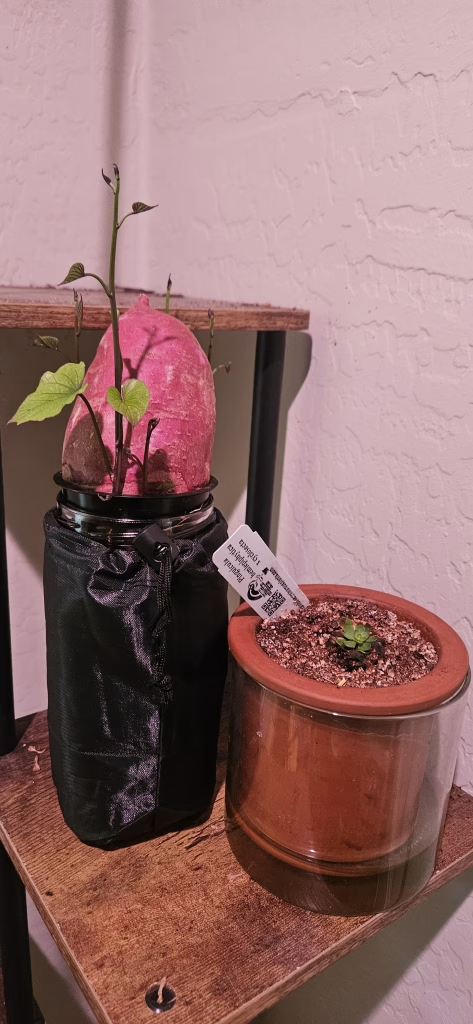
Simple Passive Hydroponic Lettuce Setup
This setup grows one or more leafy greens in a non-circulating reservoir. It is designed for low maintenance, compact spaces, and first-time hydroponic growers.
Materials/Tools
- Opaque reservoir with lid
- Net pot or net cups
- Growing medium such as perlite, clay pebbles, or rockwool
- Hydroponic nutrients
- pH test kit or digital meter
- Drill and hole saw or cutting tool
- Seedlings or seeds
Step 1: Choose the right container
Pick a food-safe, watertight container that blocks light. For one lettuce plant, a large mason jar or a one-gallon container is a common small-scale option, while larger crops need larger buckets or totes.
Step 2: Cut the lid for net pots
Drill or cut holes so the net pot fits snugly in the lid without falling through. A 2-inch opening is common for lettuce-sized net cups in beginner systems.
Step 3: Mix the nutrient solution
Fill the container with clean water and add hydroponic nutrients according to the product label. Do not guess or overfeed, because more nutrient is not automatically better in a passive reservoir.
Step 4: Adjust the pH
After mixing nutrients, test the solution and bring it into range. A common target for hydroponics is pH 5.5 to 6.5, with many leafy greens doing especially well around 5.5 to 6.0.
Step 5: Set the starting water level
Position the solution so it just touches the bottom of the net pot or sits slightly below it, depending on the seedling stage and medium. In passive deep water setups, partial contact at the start helps roots transition into the reservoir while the air gap forms later.
Step 6: Place the plant and medium
Set the seedling into the net cup and surround it with your growing medium so it stays upright. The medium supports the crown while roots grow down toward the nutrient solution.
Step 7: Block light from the reservoir
Cover any clear surfaces with foil, wrap, or paint on the outside. Light leaking into the nutrient solution encourages algae and can make root-zone hygiene harder to maintain.
Step 8: Put the system where it will grow
Place the container where it will get stable light and where you do not need to move it after filling. Once a reservoir is full, it becomes heavy and awkward to relocate safely.
Step 9: Monitor without overhandling
Check pH, water level, and root appearance regularly, especially at the start. A passive system should be low maintenance, but not ignored, because early drift is easier to correct than late-stage stress.
Setup tips that save beginners trouble
- Start with leafy greens before trying fruiting crops.
- Keep containers opaque from day one.
- Use a simple nutrient line and follow the label rate.
- Track pH every 1 to 2 days at first until you learn your water and nutrient behavior.
- Avoid crowding; one healthy lettuce per small container is easier than several weak plants.
What pH and EC should you aim for?
For most passive hydroponic crops, pH 5.5 to 6.5 is the broad working range. Leafy greens are commonly kept toward the lower end, and lettuce-friendly targets often land around pH 5.5 to 6.0.
EC depends on crop type and growth stage. For leafy greens, a practical range is often around 0.8 to 1.2 mS/cm for lettuce, while broader leafy green ranges can extend up to about 1.2 to 2.0 mS/cm.
Quick reference ranges
| Crop type | pH range | EC range |
|---|---|---|
| Lettuce | 5.5 to 6.8 | 0.8 to 1.2 mS/cm, sometimes up to 1.6 |
| Leafy greens, general | 5.5 to 6.0 or 5.5 to 6.5 | 1.2 to 2.0 mS/cm |
| Fruiting crops, general | Around 5.8 to 6.5 | 2.0 to 3.5 mS/cm |
In passive systems, stable roots often matter more than chasing exact numbers. A clean reservoir, correct crop choice, and a pH that stays in range usually do more for success than trying to optimize every decimal point.
How much maintenance does passive hydroponics need?
Less than many active systems, but not zero. You still need to watch pH, water level, temperature, light leaks, and root health, especially during the first couple of weeks when the plants are establishing.
Weekly maintenance checklist
- Check pH and adjust in small increments if needed.
- Inspect roots for browning, slime, or smell.
- Look for algae on the lid, reservoir wall, or medium surface.
- Remove dead leaves and debris from around the system.
- Confirm the plant still has a healthy air gap above the solution in non-circulating setups.
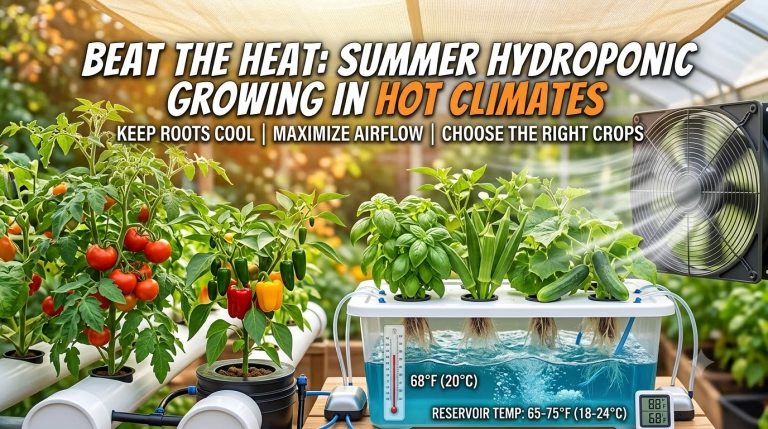
In warm rooms, maintenance becomes more important. Higher solution temperatures can reduce dissolved oxygen and increase root disease pressure, which is one reason passive setups are often easier in cooler indoor spaces than in hot, sun-baked corners.
Hydroponic water temperature guide → Water Temperature Management and Cooling Solutions in Hydroponic Systems
What problems happen most often, and how do you fix them?
Most passive hydroponic failures come from a short list of issues: low oxygen, light leaks, nutrient imbalance, poor sanitation, and choosing a crop that is too demanding for the reservoir size. The good news is that each of these problems is manageable once you know what to look for.
Yellow leaves
Yellowing can point to pH drift, nutrient imbalance, or general stress. Check pH first, then review nutrient strength and overall plant vigor before adding more fertilizer blindly.
Slimy or brown roots
This usually indicates oxygen stress, heat, pathogens, or a combination of the three. Improve sanitation, block all light, and consider whether the container is too warm or the crop is too large for true passive growing.
Stunted growth
If growth stalls, review light, pH, EC, and root space together. Lettuce and herbs need enough light and an appropriate nutrient range, even in low-tech systems.
Rapid water loss
A shrinking reservoir can simply mean the plant is growing fast, but it can also signal that the container is undersized for the crop. Large fruiting plants often need much more solution volume than a beginner passive build provides.
When is passive hydroponics the best choice?
Passive hydroponics is a strong fit when you want simple, quiet, small-scale production with low startup cost. It works especially well for apartment growers, classroom projects, windowsill herbs, and hobby growers who want a clean way to produce greens without soil.
It is less ideal when you want maximum growth rates from tomatoes, peppers, cucumbers, or other long-cycle crops. In those cases, an active system such as DWC, drip, or ebb-and-flow often offers better oxygenation and more room for correction.
Best-use scenarios by grower level
| Grower level | Best passive use case |
|---|---|
| Beginner | One to four lettuce or herb containers under a window or grow light |
| Intermediate | Multi-site tote for greens, basil, bok choy, and salad mixes |
| Advanced | Seasonal low-input side system for greens, trials, or backup production |
For many home growers, passive hydroponics is not the final system. It is the easiest system to learn from, and that makes it one of the most useful.
FAQ
Is passive hydroponics good for beginners?
Yes. Passive hydroponic systems are among the easiest hydro methods to build and run because they use few parts and no recirculating pump in the basic design. They are especially beginner friendly for lettuce and herbs rather than large fruiting plants.
What is the cheapest passive hydroponic system to start with?
A small Kratky setup is usually the cheapest option. Many growers start with a one-gallon or similar opaque container, one net cup, growing medium, nutrients, and a pH test kit.
Do passive hydroponic systems need electricity?
Not always. A basic passive reservoir such as a Kratky container can run without pumps or air stones, although you may still use electricity for grow lights if sunlight is not enough.
How long does it take to harvest lettuce in passive hydroponics?
Many lettuce crops are ready in about 5 to 6 weeks from transplant under healthy conditions. Some growers begin harvesting baby leaves around week 3 to 4, depending on variety, light, and growing goals.
Can you grow tomatoes in passive hydroponics?
You can, but it is usually more difficult than growing greens. Tomatoes are heavier feeders and larger plants, so they generally need larger reservoirs and tighter management than beginner passive systems provide.
What pH should passive hydroponics be?
A common working range is pH 5.5 to 6.5. For leafy greens, many growers aim near 5.5 to 6.0 to support nutrient availability and steady growth.
How often should you check pH in a passive system?
At the start, checking daily or every 1 to 2 days is a practical routine until you see how stable your water and nutrients are. Once the setup is stable, you may not need to adjust as often, but regular checks still prevent bigger problems.
Why are my roots brown in passive hydroponics?
Brown or slimy roots usually point to low oxygen, warm nutrient solution, pathogen pressure, or light getting into the reservoir. Check sanitation, block light, review plant size versus container size, and make sure the root zone still has access to air.
Do you top off a passive hydroponic reservoir?
Growers handle this differently depending on crop and system style. In practice, topping off too often can change how the air gap forms, so beginners usually get the best results by following a clear crop-specific method rather than improvising mid-grow.
Author note
This article reflects hands-on hydroponic growing experience across very different climates, from hot, dry conditions in Phoenix, Arizona to the cooler seasonal patterns of Michigan. That contrast matters because passive systems behave differently when room temperature, humidity, and light intensity shift through the year. The focus has remained practical indoor and urban food growing, especially simple systems that help home growers harvest greens reliably in limited space. Clear setup methods, realistic nutrient targets, and crop-to-system matching are at the center of that approach.
Share this:

Discover more from Soil Free Harvest
Subscribe to get the latest posts sent to your email.